
You know what a black hole is. Everyone does. The dark thing that swallows everything. But here is what almost nobody tells you. A black hole is alive. It has a temperature, like a cup of tea. It holds more information than you can wrap your head around. It leaks energy into space, and one day, very far from now, it will simply vanish. This is its story.
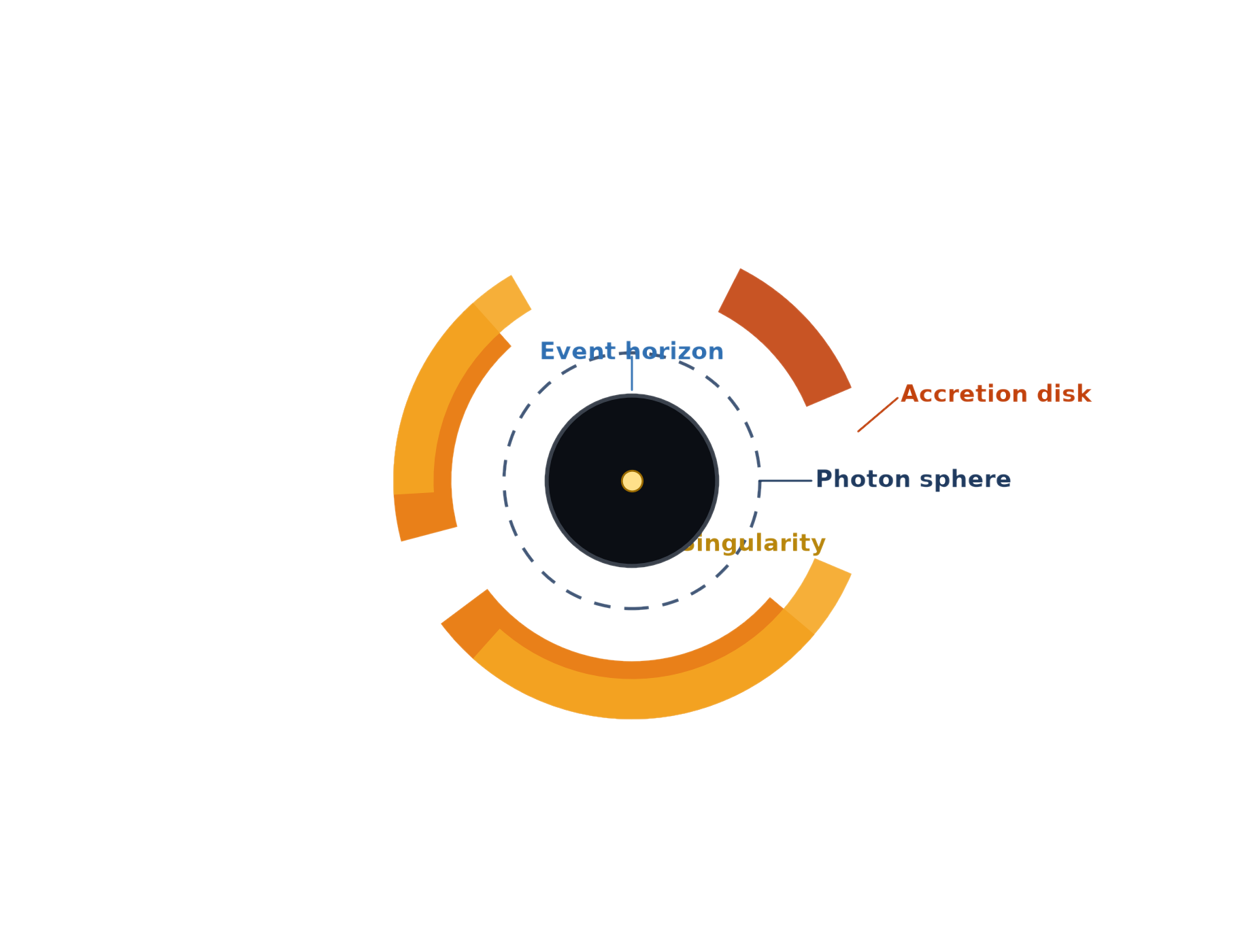
You might picture the birth of a black hole as a moment of pure drama. It is better to say it is simply inevitable. Imagine a star twenty times heavier than the Sun. It burns through its fuel in a few million years, an eyeblink by the standards of the cosmos. Then the fire runs out. Without the outward push of that fire, gravity wins the argument in less than a second. The core collapses, and it does not stop at the white dwarf stage or the neutron star stage. It keeps going, down to a point smaller than an atom’s nucleus, holding everything the star ever was. That point is the singularity.
Born in a Fraction of a Second
Think about escape velocity. To leave a planet, a rocket must reach a certain speed:
v_{\mathrm{esc}} = \sqrt{\frac{2GM}{R}}Squeeze the planet smaller and that speed grows. Squeeze it until the escape velocity equals the speed of light, and you have found the Schwarzschild radius:
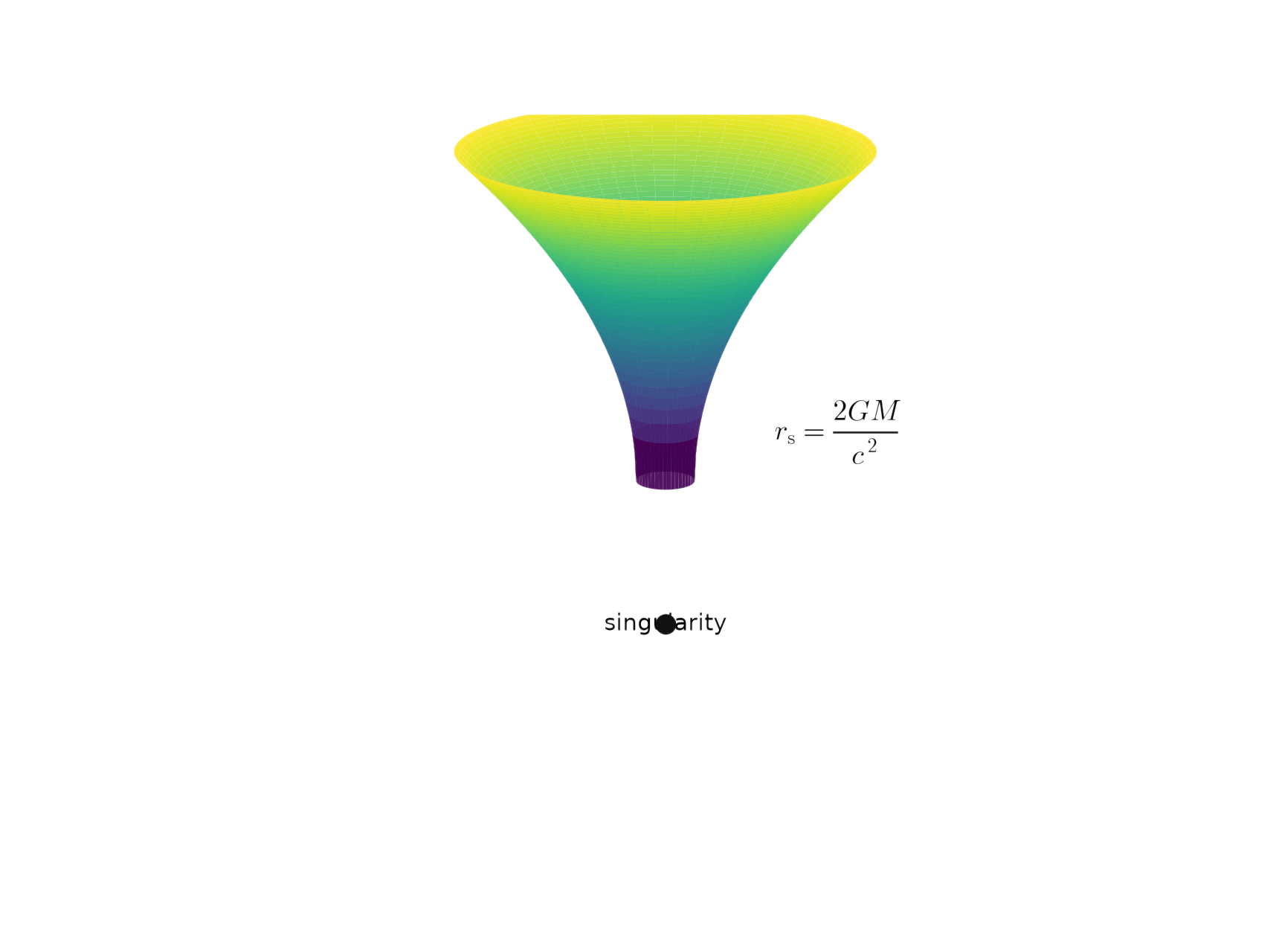
r_{\mathrm{s}} = \frac{2GM}{c^2}For the Sun, that radius is about three kilometres. For the Earth, about nine millimetres. Once the collapsing core crosses that line, nothing it contains can ever climb back out. Not a particle. Not a photon. Not even a scrap of information. The event horizon closes like a lid. What is left is a black hole.
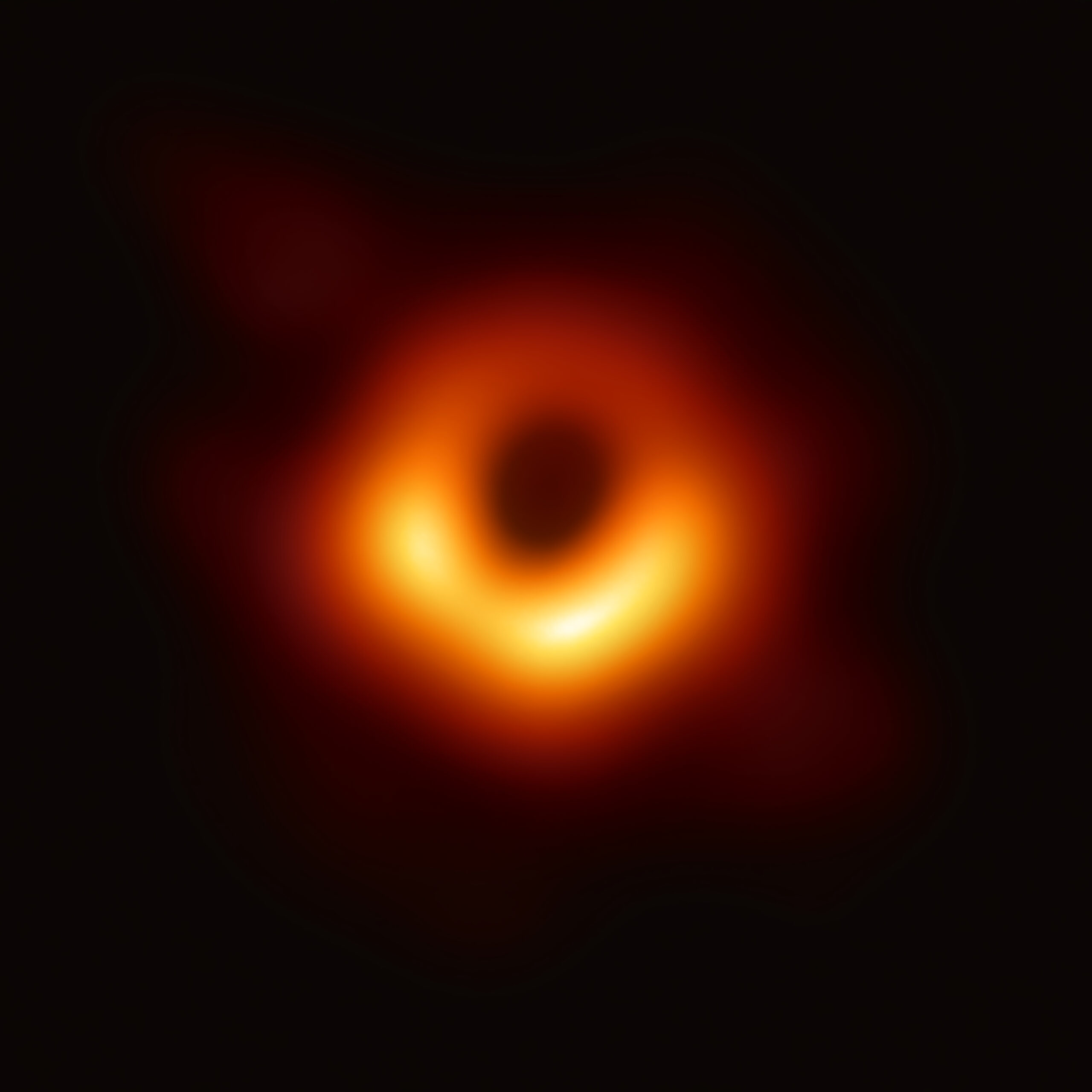
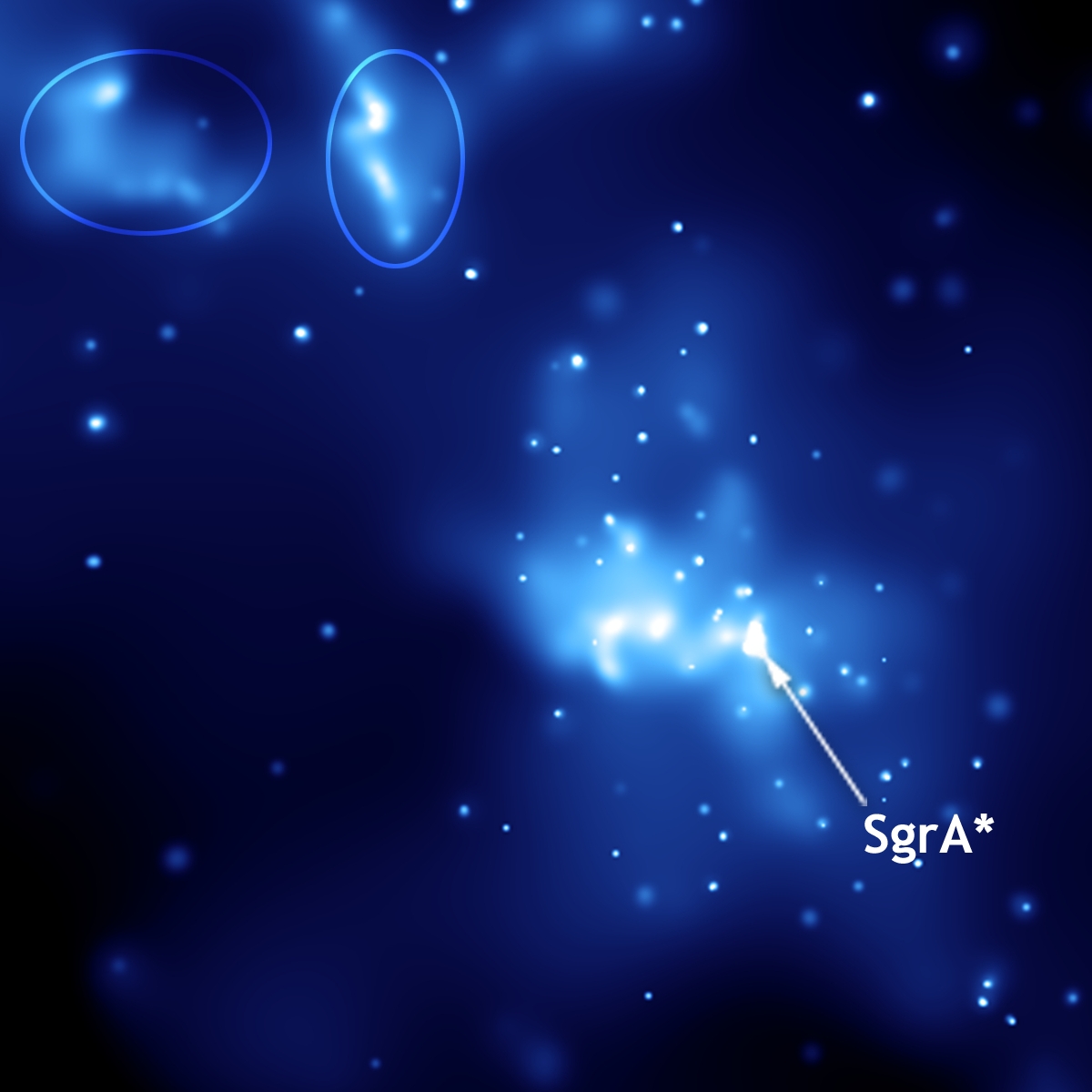
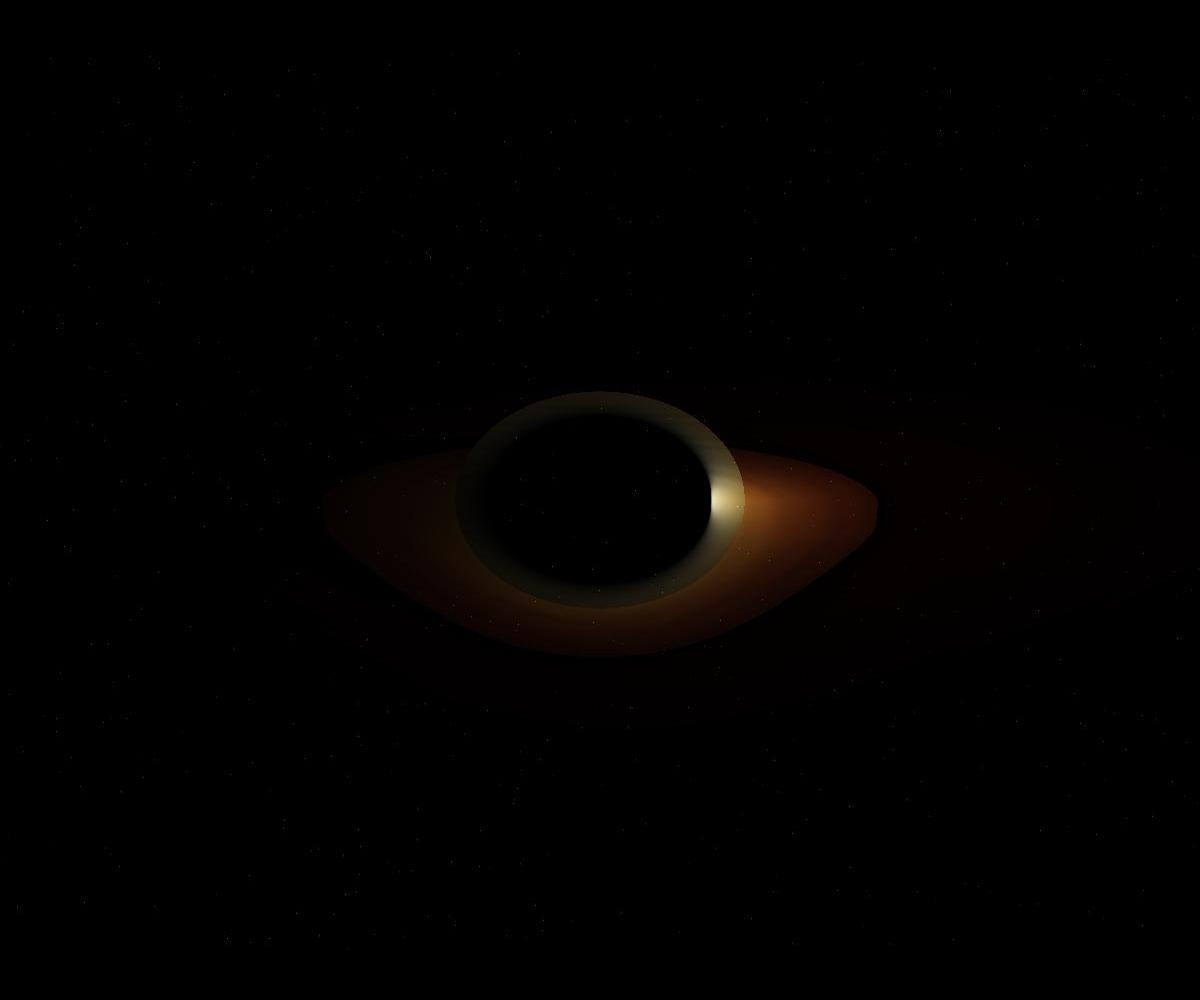
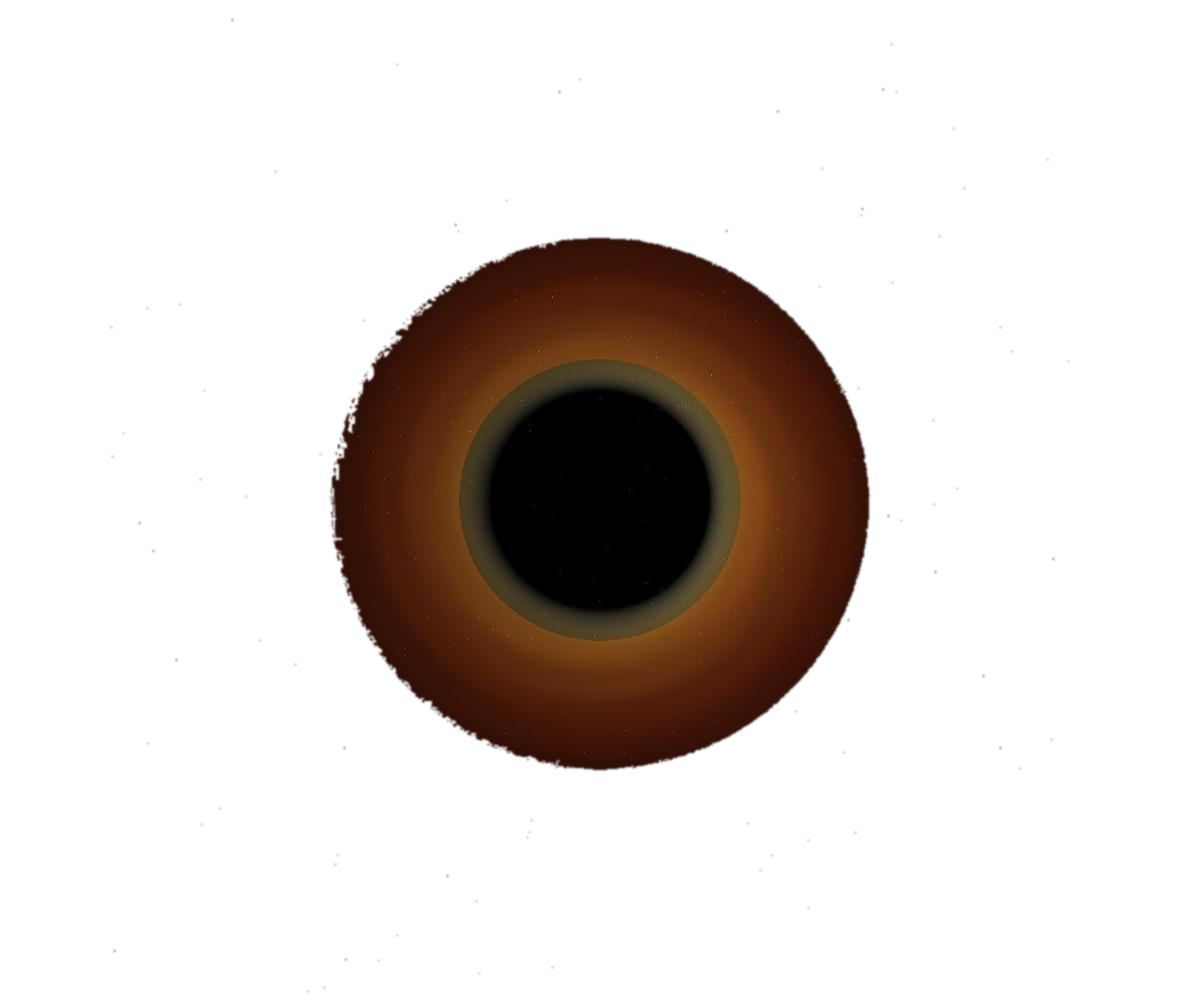
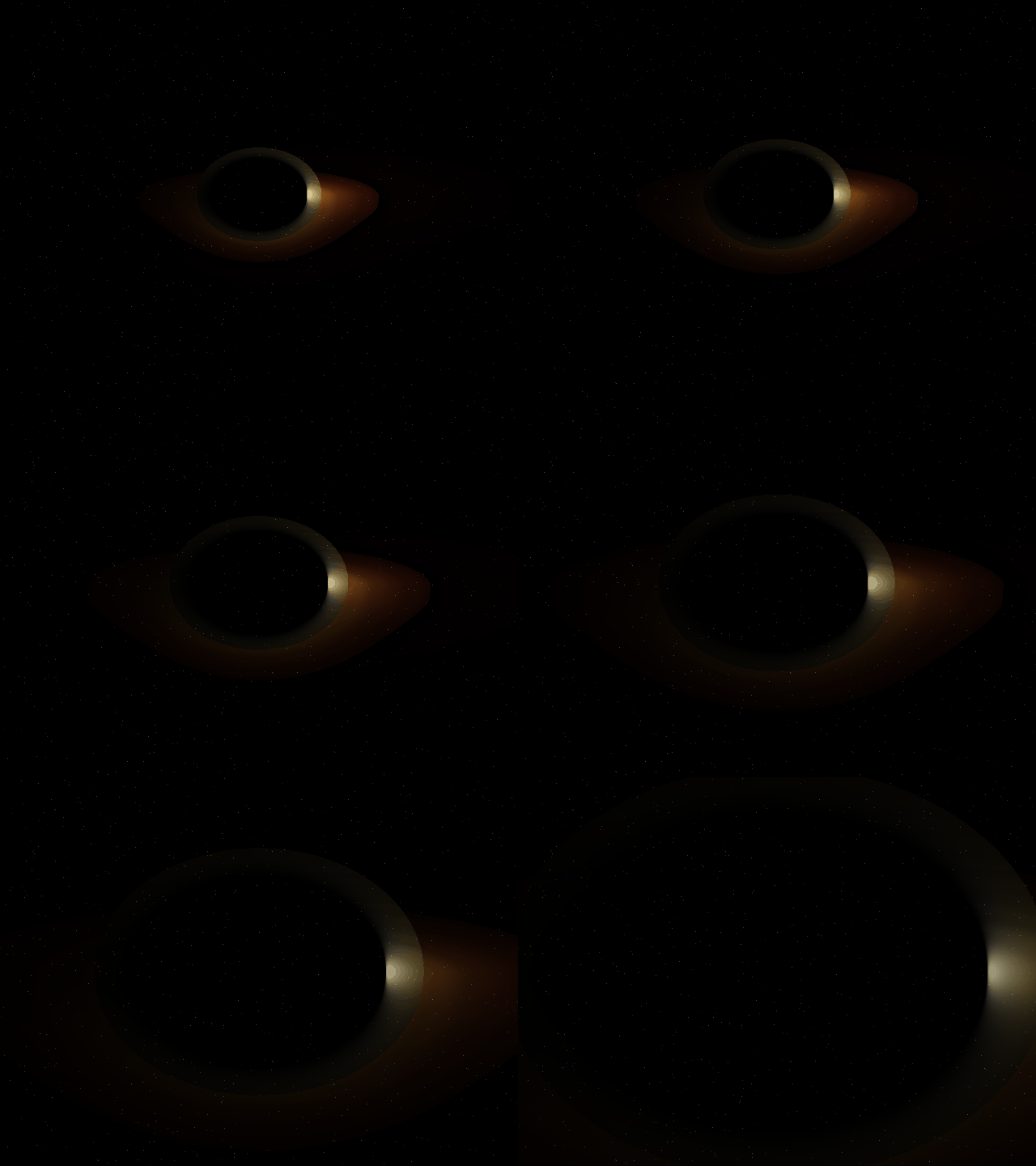
Light that passes near the hole, but not through it, gets bent harder than around anything else in nature. The hole itself throws a shadow onto whatever glows behind it. That shadow is what the Event Horizon Telescope photographed in 2019 around the giant at the heart of galaxy M87, and again in 2022 around the one in the middle of our own Milky Way, Sagittarius A*.
A Ledger That Must Balance
Thermodynamics is the universe’s accounting system. Its second law is the strictest rule in physics. Entropy, the amount of hidden information in a system, never decreases. So throw the most organized object in the cosmos into a black hole, and the universe’s ledger quietly loses billions of lines of fine print. For years this looked like a fatal flaw. Then a graduate student named Jacob Bekenstein proposed the obvious and outrageous fix. The black hole itself must be storing the entropy. And it stores it not by volume, but by the area of its horizon:
A = 4\pi r_{\mathrm{s}}^2 = \frac{16\pi G^2 M^2}{c^4}S_{\mathrm{BH}} = \frac{k_{\mathrm{B}} c^3 A}{4G\hbar}A black hole with the mass of the Sun holds about 10^{77} units of entropy. That is more than all the ordinary matter of the star that gave it birth. Sagittarius A*, the quiet giant at our galaxy’s center, holds around 10^{90}. By the rules of thermodynamics, a black hole is the most information-dense object the universe has ever built.
This made Stephen Hawking uneasy. Anything with entropy must have a temperature. Anything with a temperature must radiate. And a black hole that radiates is a black hole that shrinks. Every physicist knew a black hole cannot shrink. Hawking himself had proved that the area of horizons can only grow. In 2015, gravitational-wave detectors watched the theorem play out in real time, as two black holes merged into one whose area exceeded the sum of its parents. The contradiction was perfect. Hawking spent two years looking for the escape hatch. He found it in the quantum vacuum.
The Faint Warmth
The vacuum is not empty. Quantum mechanics insists it seethes with pairs of particles that borrow energy from nothing, exist for a split moment, and annihilate each other. Near an event horizon, gravity tears a pair apart before they can reunite. One partner falls in. The other escapes, carrying a tiny real amount of energy with it. To you, watching from far away, the black hole is glowing.
And here is the cruelest elegance in the whole story. The escaping light has the exact spectrum of a blackbody. The hole radiates as if it were a hot sphere, with a temperature:
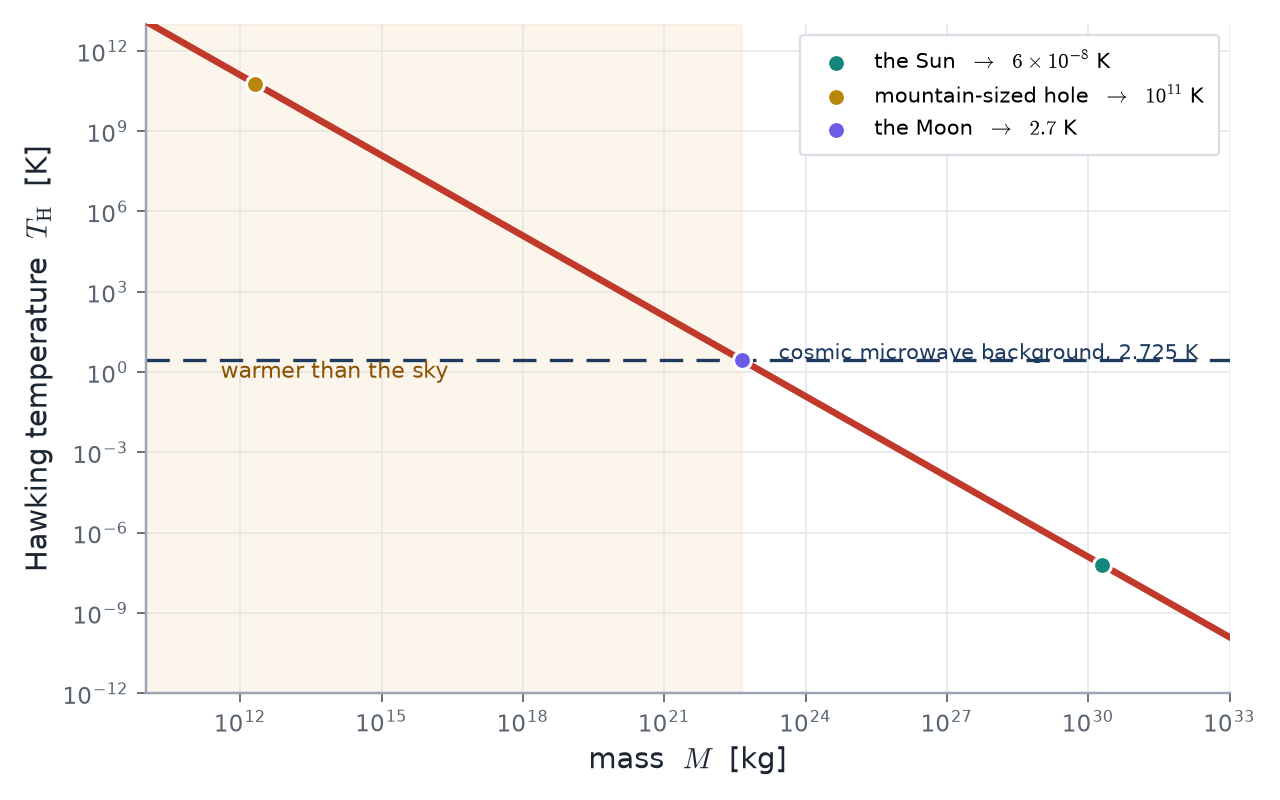
T_{\mathrm{H}} = \frac{\hbar c^3}{8\pi G M k_{\mathrm{B}}}T_{\mathrm{H}} \approx 6 \times 10^{-8}\,\mathrm{K}\left(\frac{M_\odot}{M}\right)Sixty billionths of a degree above absolute zero. Far colder than the afterglow of the Big Bang that fills all of space. A solar-mass black hole actually absorbs more radiation than it emits. It must wait for the universe to grow old and cold before it can win its long war with the void.
Smaller holes are hotter. A black hole weighing about as much as the Moon would hover at roughly 2.7 kelvin, exactly the temperature of the microwave sky. And a primordial black hole, born in the crushing chaos of the first moments with the mass of a mountain, would blaze at a hundred billion degrees, screaming gamma rays across the cosmos. A black hole’s temperature is a mirror held up to its appetite. The hungrier it is for mass, the colder it burns.
The Long Dying
So the shadow bleeds. Each escaping photon costs the hole a crumb of its mass. The horizon tightens. The temperature climbs. The bleeding accelerates. And the end, when it finally arrives, is anything but gentle.
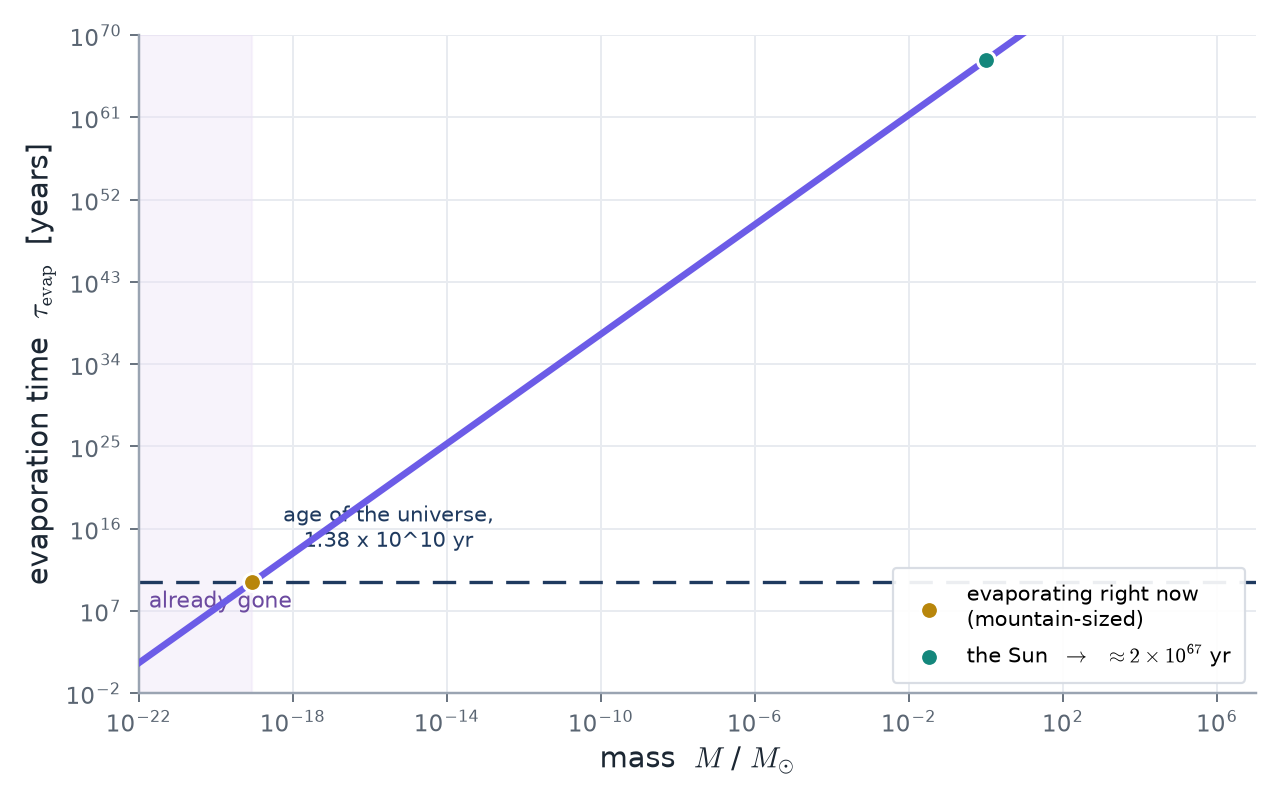
\tau_{\mathrm{evap}} = \frac{5120\pi G^2 M^3}{\hbar c^4}The lifetime scales as the cube of the mass. A solar-mass black hole would take about 2 \times 10^{67} years to evaporate. So long that the age of the universe, a mere 1.4 \times 10^{10} years, looks like a single exhale. But a black hole born small would already be gone. If primordial black holes exist, the lightest of them are finishing their lives right now, across the universe, as bursts of high-energy light with no known source. Astronomers are watching.
The Four Laws of a Shadow
The strangest part of the story is that the resemblance between a black hole and an ordinary gas is not a metaphor. It is an exact dictionary. Swap energy for mass, temperature for the pull of the horizon (the surface gravity), entropy for the area of the horizon, and the four laws of thermodynamics translate word for word:
| Law | Ordinary thermodynamics | Black holes |
|---|---|---|
| Zeroth | A system in equilibrium has one temperature. | Surface gravity is constant over the horizon. |
| First | dU = T\,dS + work terms. | dM = \dfrac{\kappa c^2}{8\pi G}\,dA + \Omega\,dJ + \Phi\,dQ |
| Second | Entropy never decreases. | Horizon area never decreases (Hawking’s theorem). |
| Third | Absolute zero is unreachable. | A horizon with zero surface gravity is unreachable. |
Hawking and Bekenstein showed the dictionary runs even deeper. The total entropy of the universe, ordinary matter plus a quarter of the black hole area in Planck units, never decreases:
dS_{\mathrm{tot}} = dS_{\mathrm{matter}} + \frac{c^3}{4G\hbar}\,dA \geq 0Physicists still do not fully understand why the dictionary works. That is precisely the point. When a piece of physics works this well, it is usually trying to tell you something deep about the structure of reality.
The Question That Won’t Lie Down
If a black hole evaporates completely, and the radiation it emitted was purely thermal, carrying none of the fingerprints of what fell in, then the information inside it is destroyed. And quantum mechanics, which insists information can never be destroyed, would be wrong. For fifty years this information paradox has refused to go away. Hawking eventually conceded a famous bet on it. The most recent answers, assembled around 2020, suggest something almost philosophical. The escaping radiation is secretly entangled with the radiation that left earlier. The information is never lost. It is only scrambled beyond the reach of any single observer, in a way the universe, but not you, can read.
Epilogue: The Warm Shadow
None of this was ever really about black holes. It is about the discovery that thermodynamics, the lowliest and most bookkeeping corner of physics, is actually the deepest. Black holes are the only places where gravity, quantum mechanics, and the second law all bite at once. The laws they obey there look like the first real letter we have received from quantum gravity.
A black hole is not a corpse. It is a hearth. It burns, slowly, at a temperature set by its own mass, for a span of time longer than we can name. And when it finally goes out, it goes out with a scream.
That, and nothing else, is what it means to say the shadow is warm.